Listening to “Accounts of Practical Fighting” from Elder Bushi Motobu Chōki!
Ryūkyū Shinpō, 9, 10, and 11 November 1936
Wakugawa Seiei Collection, Okinawa Prefectural Archives
Translation by Motobu Naoki
Roundtable Hosted by Young Karateka — Part One

At the height of the karate fever both in and out of Okinawa, young martial artists from Naha and Shuri, who maintained that “karate must reject empty theorizing and remain practical in every respect,” gathered on the 7th of the month at 8 p.m. at Tsuji Uenorō. There, a roundtable was held around Motobu Chōki, the foremost practical fighter in karate, to hear his accounts of actual fighting and personal experiences.
Among those who gathered were Takamine Chōkei, Nagamine Shōshin, and Uezu Angi of the Naha Police Department; Shimabukuro Tarō and Kin Ryōshō of Shuri; Miyazato Ryōkichi of Kakinohana; and Yanagisawa Shichirō of the Okinawa Prefectural Educational Affairs Section.
As they sat around Elder Motobu, whose sturdy physique made it hard to believe that he had already passed the age of sixty, these men of shared interest spoke freely among themselves about karate and the martial arts, and the conversation became increasingly lively. Eventually, Elder Motobu himself stood up and, using the younger men as partners, demonstrated kata and techniques for actual situations, displaying a vigor that rivaled — indeed surpassed — that of men in their prime.
The following are Elder Motobu’s fascinating recollections of his youth, accounts of actual fighting, and anecdotes about the masters of former times, as told in response to the questions posed to him.
Differences Between Naihanchi Now and in the Past
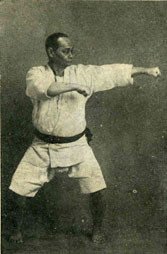
The way the hand or fist is formed is different now from the way we were taught when we were twelve or thirteen years old. In the old days, it was an open hand, or hirate (“flat/open hand”). Today, the punching fist is extended forward with a downward slant, in what is called mizu-nagashi (“water-flowing”), but in the old days there was no such hand technique. It was thrust straight, if anything with the feeling of rising slightly upward. I believe that the Matsumura line of Shuri preserves the authentic form.
The technique, or kata, of Sakuma Sensei and that of Matsumura Sensei were the same. In the old kata, we were taught that after thrusting and extending the fist, when drawing it back, it should be pulled to the armpit. However, today, after thrusting and extending the fist, when drawing it back, it is brought to the side of the abdomen. This is absolutely of no use in actual fighting. The correct way is to put power into the drawing-back motion, but I cannot help finding it strange that today power is put into the outward thrust of the fist. Even if the thrust is done with eight-tenths of one’s power, the pulling-back force should be ten-tenths.
Stories About Karate Masters of the Past
I was taught by such renowned men of Shuri as Matsumura¹ and Sakuma². I also trained from time to time under Matsumora of Tomari,³ Kunigami Pēchin, Itosu,⁴ and “Yanbaru” Kunishi of Kumoji.⁵ Among all these instructors, the two with whom I felt the greatest affinity were Matsumora of Tomari and Sakuma.
I was struck a great deal during training, but Sakuma Sensei taught me well, sometimes praising me and sometimes scolding me. Through practicing irikumi (paired combat practice) with him, I began to develop real ability, to the point that I could deal with my peers as if they were children. Matsumora of Tomari was about one sun taller than us, about five shaku four sun in height, and weighed about 120 kin. His build was just like that of an earthenware jar. His method was totally different from Itosu’s. Sakuma, too, was just like Matsumora, and in terms of strength, he was truly a bushi.
- Matsumura Sōkon
- Sakuma Pēchin: The head of Sakuma Dunchi (a noble house). In Motobu Chōki Sensei’s Watashi no karate-jutsu, he praises Sakuma Pēchin as “Sakuma the Wise.”
- Matsumora Kōsaku
- Itosu Ankō
- Kunishi Shinkichi (Kuniyoshi in Japanese)
Martial Artists of Today and Martial Artists of the Past
Compared with our teachers of the past, I do not think that among today’s young bushi there is anyone who has trained enough to be called a martial artist. At most, they seem only to be practicing. In my view, there is no one today who can truly be called a musha (a master of real martial ability).
Roundtable Hosted by Young Karateka — Part Two
How the Bushi of the Past Trained!
Matsumora of Tomari and others would go out to Katabaru on moonlit nights and, saying “Not yet, not yet,” train until their legs and hips could no longer support them. Around daybreak, when they returned home, they were so exhausted that they could not even step up into the house and would end up lying down and sleeping on the veranda. That is how fiercely they trained. In their training, kata and kumite were practiced together.
As for what the martial artists of the past aimed for: in those days, even when learning te (“hand,” the old fighting art), people would go secretly to their teacher’s house so that no one would see them. They would go while it was still dark, before day had fully broken. Even when practicing on the makiwara, they took care not to make any sound. In bō practice as well, they wrapped the staffs with straw so that they would not make a clacking sound.
Story of Winning a Ten-Yen Bet Through ukete (“receiving hand”)

This happened when I was about twenty years old. When Kameya, Yabu Kentsū,¹ and my older brother² went to Matsumora Sensei of Tomari for instruction, the teacher asked them about ukete (“receiving hand”). I heard that even after puzzling over it for a whole week, they still could not understand it.
So I told them, “Something like that is easy; I could do it right away.” My older brother and the others became greatly angered and said, “If you can do it, then let’s make a bet.” So we made a ten-yen bet and went together to Matsumora Sensei’s place. I said to him, “The ukete you gave my older brother and the others the other day — I can do it. May I try?” When I lightly performed the receiving technique, Matsumora was surprised and said, “I have never taught this technique to anyone. How did you understand it? Who is your teacher?”
I answered, “Itosu.”
Matsumora said, “I know Itosu well myself. Then can you bring Itosu here?”
I replied, “Yes.”
When I brought Itosu Sensei to Matsumora’s place, Matsumora said, “This young man shows promise for the future, so let us train him together.” After that, I received various instruction. Itosu would often praise Matsumora, almost as if it were his favorite saying: “A bushi like Matsumora is a true bushi.”
That is how I won the bet with my older brother and the others and made ten yen. Ha, ha, ha... In actual fighting, there is no such technique as receiving with the left and entering with the right, or receiving with the right and entering with the left. The hand that receives must instantly turn into an attack. Today’s kumite simply takes karate kata as they are and uses them, but that is of no use at all in actual fighting.
- Yabu Kentsū
- Motobu Chōyū
Story of Causing Matsumora to Bleed from the Teeth with a Single Strike
Kin Ryōshō asked:
“My father, Kin Ryōjin, often used to say, ‘Mr. Motobu is a true bushi.’ He also told me that Matsumora praised you, saying, ‘A man named Motobu came to my place, and when we practiced
irikumi, he once landed a strike to my face. For someone so young, he had exceptional martial talent.’ Is this story true?”
Motobu answered:
“It happened when I was about nineteen. I went to Matsumora’s place with Tamashiro of Kariya,¹ a sumō wrestler, and received irikumi training there. When Sensei sent in the second
technique, I received and deflected it, and from there struck him in the face. Sensei began to bleed from the teeth, so I said, ‘Sensei, excuse me,’ and took one step back. Sensei said, ‘Never
mind that. Keep coming in boldly.’ I was deeply moved by this and, with renewed determination, trained all the harder. This is true.
I never told anyone about this, but Yabu said that he had heard about it too. There was a bushi named Kameya in Shuri Kubagawa. Kameya was about ten years older than I was, and he was strong. I could barely receive his techniques even with both hands. From about the ages of eighteen or nineteen until twenty-one or twenty-two, he often handled me roughly, but because I trained with all my might, by the time I was about twenty-three, Kameya could no longer do anything against me.”
- Kariya was the site of the former Satsuma magistrate’s office in Naha.
Roundtable Hosted by Young Karateka — Part Three
Story of Playing a Prank on His Friends While Wearing a Mask

On one occasion, Hanashiro,² the powerful Takaesu of Īfu, Nakandakari of Mīke, Yabu, and the others were all together and were about to enter an establishment frequented by Yabu near Shittai Gate in Tsuji.¹ I happened to encounter them and, so that they would not realize it was me, put on a face covering, or kōgakī, and cut in toward Takaesu. When he came at me, I parried and struck him both times, and Takaesu became unsteady and staggered back in confusion. Hanashiro, Yabu, and the others saw this, but instead of trying to help Takaesu, they tried to go farther inside. So I clapped my hands, laughed, and took off the face covering. Only then did they realize it was me. Hanashiro and Yabu said, “We thought no one but Motobu could make Takaesu stagger like that, and sure enough, it was you.” We all laughed together and had a drink.
- Tsuji was Naha’s pleasure quarter.
- Hanashiro Chōmō
Story of Making the Bushi of Naha Run Away
This is the story of my encounter with Okuhama, a bushi of Naha and the jitōdai (“local administrator”) of Katabaru. When I was thirty, Yabu and I were on our way home after spending time at a pleasure house in Tsuji that Yabu frequented. At Ue no Kado in Tsuji, we were surrounded by bushi of Naha. When one of them rushed in, I stepped back and instantly took down one man, who collapsed where he was. Perhaps frightened by the force of this, no one else came at us, and they all ran away.
- Ue no Kado was a location within Tsuji.
The Disturbance at the Village Performance When I Was Surrounded by the Bō-gumi
It happened when I went to watch the village performance at Nishibaru Onaha together with Itarashiki Tanmē¹ and others. I was unaware that members of the bō-gumi² were saying something to me from behind, when one of them suddenly struck my hand with a bō, and in the same motion it struck me in the groin. I crouched down, enduring the pain, but as soon as the pain subsided, I turned back and instantly took down the man behind me. Then there was a great commotion.
About seventy or eighty members of the bō-gumi surrounded us and came at us. The people who had come with me were the first to flee to safety, so I was left behind and, while fighting them in actual combat, jumped over a stone wall and fortunately broke through the encirclement and made it back. Because of the commotion, the people from Shuri thought, “Motobu must already have been killed,” and came out searching for me with lanterns. I encountered them on the way.
At that time, my parents were among them, and I did not want to worry them. So I straightened my kimono, which had become wrinkled in the actual fighting, put some sand into both sleeves to restore the parts that had become crumpled, and told my parents, “Nothing of the sort happened.” But it really was a tremendous commotion.
- Itarashiki Chōiku. Tanmē is an Okinawan honorific for an elder of the shizoku class; the corresponding term for a commoner elder would be usumē.
- The bō here refers to the staff used in village performance, though in this incident it was used as a weapon.
Story of Fighting a Foreign Boxer in Actual Combat and Knocking Him Down

I think it was around 1923 (Taishō 12).¹ I went to watch a foreign boxer, John something-or-other, giving an exhibition in Kyoto. At first, he was fighting a judo practitioner, but the boxer’s movements looked very crude and flat-footed, so I thought, “This man is an amateur.” I made a wager on the outcome and then applied to take part in the match myself.
This was after I had passed the age of fifty. I was unable to fight that day, so I entered the match the following day. When I said that I would face him bare-handed, without gloves, the boxer, who was much taller than I was, looked down on me considerably and treated me like a child, pulling my ears, pinching my nose, and twisting my cheeks.
In the first round, I merely handled him lightly, and then we took a break. When I stood up for the second round, a thought suddenly came to me: “If I lose to a foreigner like this, it will be a disgrace not only to karate but also to Okinawa. I will give him a thorough beating.” Resolving this, I went on the offensive with determination. The instant he came charging in with force, I struck him hard on the temple with a single blow, and he collapsed splendidly on the spot.
The spectators became excited. They threw floor cushions, tobacco pouches, and money pouches toward the place where I was standing, applauding and cheering. It caused a great sensation, because I had defeated with karate a boxer who was about six shaku tall.
At the time, it was widely reported that I had slapped him with an open hand, but as if I would face an opponent with an open hand. The thrust of my fist was so fast that the spectators
apparently thought it was an open hand. Karate’s specialty is to move softly, then, when an opening appears, strike instantly. That is karate in actual fighting.
(End)
- In the interview in Ryūkyū Shinpō, Motobu Chōki Sensei’s recollection was that his fight with the boxer took place in 1923 (Taishō 12). By contrast, the 1925 issue of King magazine stated that this famous event took place in November 1922 (Taishō 11).